
Mahnomen County Criminal Docket Searches
Start remote Mahnomen County criminal docket searching at Minnesota Court Records Online, or MCRO. Pick Criminal as the case category. Then choose Mahnomen County from the county list. A complete court file number is the fastest route in. A filing-date range can narrow a party-name search when you lack one. MCRO labels the case-detail screen Case Details (Register of Actions). That screen is a public chronological view of the case rather than a certified court record.
For an upcoming setting, run an MCRO Hearing Search. Compare it against the official Mahnomen calendar. Where remote data falls short, the courthouse offers a Minnesota Public Access terminal, called MNPAC. Court Administration can also pull an older paper or off-site file and make copies. One caution: Minnesota eFile and eServe, known as eFS, is the filing and service tool for authorized filers. It is not a public docket search.
- Open MCRO Case Search and choose the Criminal category.
- Select Mahnomen County, then enter a complete case number or a carefully narrowed name search.
- Open the matching Case Details (Register of Actions) record and compare its filing date, category, and court location.
- Use Hearing Search and the court calendar when the immediate question is a public hearing date.
- Ask Court Administration for MNPAC, paper-file, plain-copy, or certified-copy help when the remote result cannot answer the record question.
Note: Treat a person-name result as a starting point only. Verify the court number and public case details before relying on it.
Mahnomen County Criminal Case Numbers
A complete file number sidesteps the pitfalls of a broad name search. The official Mahnomen calendar has shown criminal examples such as 44-CR-25-233. The CR segment signals the case type. But no universal formula covers every year or sequence. Type the full number into MCRO Case Search or Document Search. Use it with or without dashes and leading zeroes, but never with spaces. An incomplete case number triggers an error rather than a general search.
| MCRO control | How it helps a criminal search |
|---|---|
| Name Type | Choose Person for a usual defendant-name search. |
| Last, first, and middle name | Use exact text; a trailing wildcard needs at least two characters. |
| Sounds Like | Offers a phonetic option, but it cannot be combined with a wildcard. |
| Date Filed and Criminal category | Can narrow a known charging window without guessing at a case number. |
| Court Locations | Select the specific Mahnomen County court location before running the search. |
MCRO Document Search works only with the complete case number. It is not a party-name search. What it does well is surface qualifying public documents tied to a known case. Keep the case number and search date handy. Court Administration may need them to check a record that does not appear online.
Criminal Dockets: What They Show
A Mahnomen County criminal Register of Actions can list the case number, filing date, category, court location, judicial officer, public party-role labels, dated events, hearing settings, document titles, and a public status or disposition when one exists. It may also show public charge descriptions, classification, plea or sentencing-related entries, and later appeal or probation events. Read with care, though. A charge line is not a conviction. A hearing label is not a final judgment. Before concluding anything from an early event, check the later orders and disposition entries.
| Case number | The court identifier, such as the observed format 44-CR-25-233, used to retrieve the specific criminal record. |
|---|---|
| Charge block | Public offense description and classification when the case type and access level expose them; a charge does not establish guilt. |
| Register events | Dated filings, orders, plea or disposition events, sentencing entries, and public later activity. |
| Settings | Date, time, location, hearing type, judicial officer, connection label, and the related case number where public. |
| Disposition | A dismissal, conviction, sentence, probation-related outcome, or another final label only when the record actually displays it. |
Qualifying public documents may be free through MCRO. Even so, the remote screen remains an unofficial public display. For a certified judgment or order, turn to Mahnomen County District Court / Court Administration.
Mahnomen County Criminal Docket Labels
Mahnomen County publishes no local abbreviation codebook. So read the words in the Register of Actions and calendar in their procedural context. Skip the hunt for a decoder. Statuses can shift over time. A term in the event list never substitutes for the signed order or judgment. The plain-language terms here describe labels a reader might meet, not a guaranteed local shorthand list.
- Pending
- The case has not reached its recorded endpoint.
- Disposed
- The register shows a court-recorded endpoint, which should be read with the relevant order or judgment.
- Dismissed
- A charge or case ended, but a dismissal is not the same judgment as a conviction.
- Probation Violation
- A later proceeding concerning supervision, not necessarily a new criminal charge.
- Sealed or Restricted
- Public access is limited by a rule, statute, or court order.
Bond, fine, and balance fields show up only where the public case type exposes them. Likewise, a probation review or sentencing setting creates no new charge. The Register of Actions keeps events in order, so the current legal effect rests with the operative judgment or order, not a single calendar line.
Criminal Case Stages on the Docket
A Mahnomen County criminal register normally opens with a complaint, citation, tab charge, or other charging event. The public calendar has shown First Appearance, Initial Appearance - Rule 8, Arraignment, Omnibus Hearing, Contested Omnibus, Pre-trial, Review Hearing, Probation Violation Hearing, and Sentencing. Each label marks a procedural point. None is necessarily an outcome. A plea is one thing; sentencing is another. For any disposition, rely on the record entry or court-produced document that actually states it.
Docket flow: Charge Filed → Arraignment → Pretrial → Plea or Trial → Disposition → Sentencing
The record can keep moving after a disposition. Later entries may cover review, probation, satisfaction of financial obligations where shown, or an appeal. A notice of appeal can appear in the district court register, while the appeal itself lives on the separate appellate docket.
Mahnomen County Omnibus Hearing Entries
An Omnibus Hearing entry, sometimes labeled Contested Omnibus or Pre-trial, is a criminal pretrial setting. It appears on the Mahnomen calendar. It is not a verdict. What often follows are motions, evidentiary disputes, orders, or a new court date. The calendar tells you why a matter is set. The Register of Actions gives the dated event history and any later order, so treat it as the stronger source for a Mahnomen County court docket review.
Need a hearing date the public can see? After locating the case, check the official Mahnomen calendar PDF. It is posted each business day and updated hourly. The printed calendar in the courthouse lobby or outside the courtroom is even more current. If the web calendar and the register disagree, a later continuance, reset, signed notice, or order may explain it. Court Administration can confirm the setting.
Note: A confidential or non-remote matter can be left off the calendar. So absence from the PDF never proves a hearing was canceled.
Mahnomen County Criminal Docket Courts
Mahnomen County criminal cases run through a single trial court: the Minnesota District Court, sitting as Mahnomen County District Court, which holds original jurisdiction over crimes charged in the county. Felony, gross-misdemeanor, misdemeanor, petty-misdemeanor, and traffic matters, plus probation or bond events, move through different procedures. Even so, none of them creates a separate Mahnomen criminal clerk, a municipal court, or a distinct justice-court search portal for a Mahnomen County criminal docket.
Mahnomen County District Court
311 N Main Street
P.O. Box 459
Mahnomen, MN 56557
(218) 935-2251
The Ninth Judicial District handles administration only, not a separate criminal case counter. Federal prosecutions sit outside this state register entirely and live in the federal court's own record system. For county-filed criminal records, Mahnomen County District Court / Court Administration is the office that holds local copies and answers access questions.
Missing Mahnomen County Criminal Documents
When a criminal document is missing from MCRO, start with the basics. Confirm the exact case number, filing date, and title against the Register of Actions. Coverage is best for criminal and civil documents filed on or after July 1, 2015. Limited court-generated material runs from 2005 through 2015. Before that, paper files were the norm. A gap can also come from an access restriction, a redaction, an expungement, retention rules, or a broken document link. The MCRO Case Search interface is the starting point for a Mahnomen County criminal docket lookup. It shows the case details the state publishes.
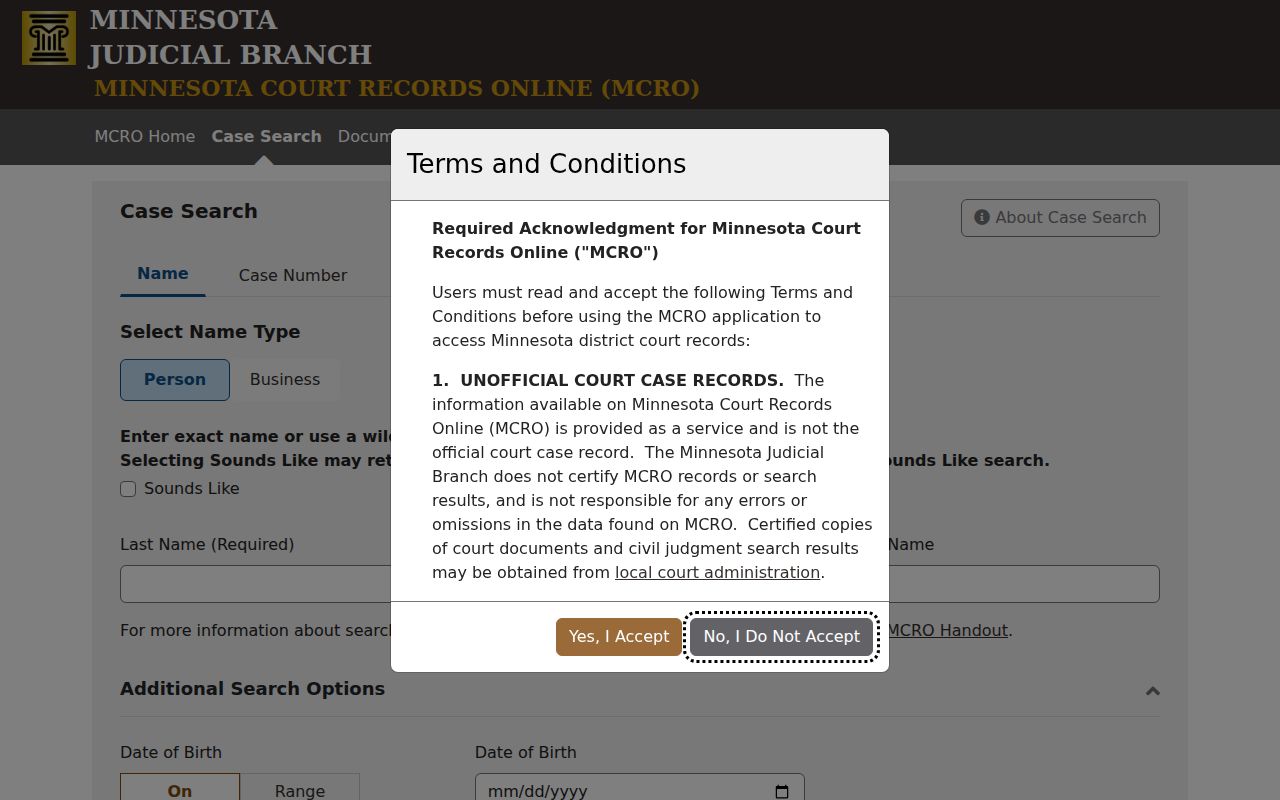
Choose the Criminal category and the Mahnomen County filter. Do this before trusting any remote result as the right case. A match on a name alone can pull in matters from elsewhere.
Still no document? Try the MNPAC terminal at the courthouse. Or ask Court Administration for a paper, electronic, plain, or certified copy. Requests work at the counter or by mail. The statewide copy-request materials also list eFS as a filing method for them. Include the case number, names, approximate year, document title, and whether you need certification. Uncertified copies are generally free under the state schedule. A certified civil or criminal instrument carries a listed base fee of $14.
Access Rules for Criminal Dockets
Mahnomen County criminal records can be searched in MCRO. You can examine them more fully on MNPAC or request them from Court Administration. Minnesota's court-record rules draw a line between remote access and access at the normal place of custody.
A criminal docket is the public index of court events. A filed document is the item itself. A certified copy is the court-produced official version. Court Administration can tell you which route fits your request.
Public-access authorities:
Minn. Stat. §13.03 states the general public-inspection and copying principle, subject to judicial-branch rules for court records.
Rule 8 governs inspection, copying, and remote access for judicial records.
Rule 4 identifies excluded records and permits case-specific access restrictions when required findings are made.
Rule 7 allows an oral or written request that reasonably identifies the record and addresses a response, delay, or denial.
A defendant-name search may skip pending criminal, traffic, and petty-misdemeanor cases that lack a conviction. Juvenile, sealed, expunged, and other restricted records face tighter limits still. So an empty result is not proof that no case exists. The reason may be simple. It may be an incomplete name, a pending matter, or restricted access. It may also be an older file, or the limits of the remote display.
Mahnomen County Criminal Record Restrictions
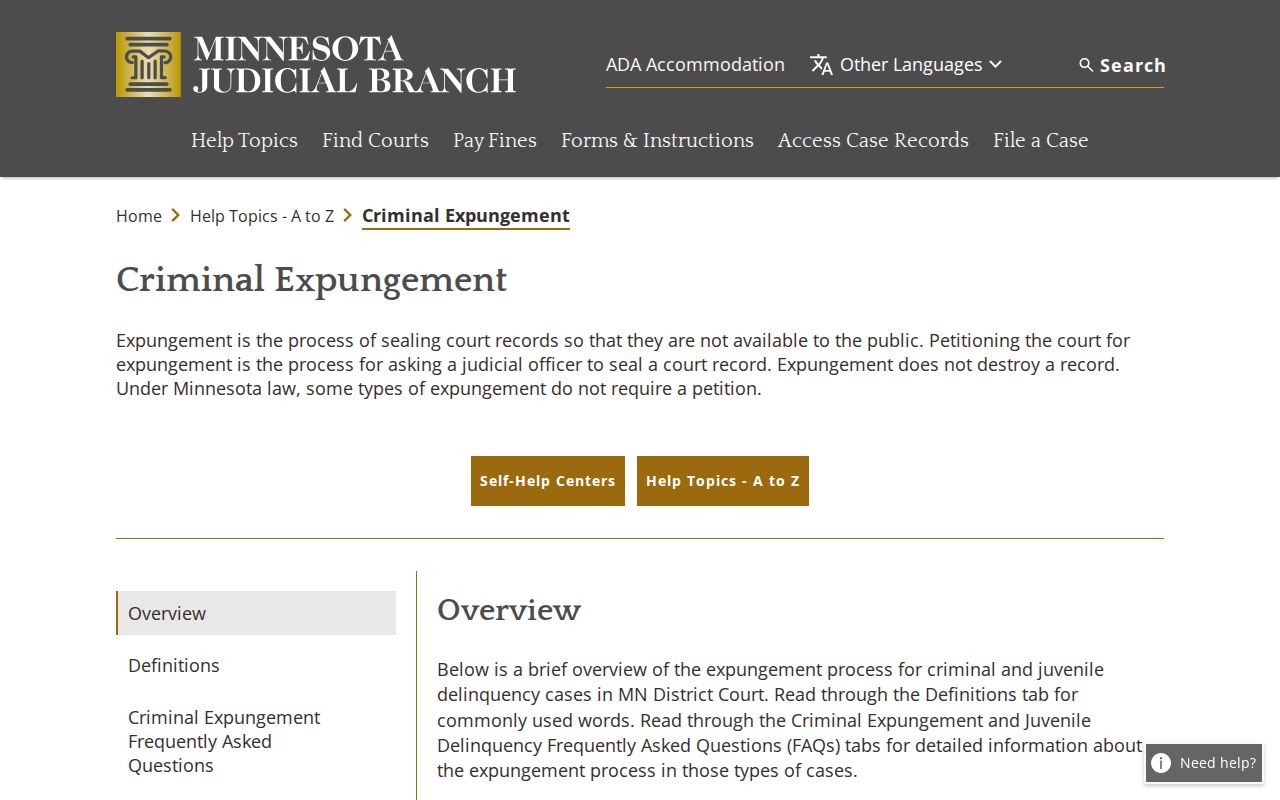
Sealed, restricted, and expunged are not interchangeable terms. Under Minnesota court guidance, a district-court judge orders a criminal record sealed through expungement. Authorized justice-system access can continue. It runs under the law or the order itself. For a confidential or sealed case, a non-party uses the CON100 or CON101 judicial-access process when required. The request lists the county, judicial district, case number if known, case type, records sought, and the requester's interest. Then a judge decides access. The Minnesota Judicial Branch's criminal expungement overview explains the state-level sealing process. That process can limit how much of a Mahnomen County criminal docket stays visible to the public.
Reaching a restricted record depends on three things. These are the governing rule, the court's order, and your own legal status. Repeating a MCRO search will not change that. If Court Administration denies access, ask which rule applies and why. That keeps the request tied to the court record at issue. It also preserves the correct path for any judicial review.